Human CD272 Protein, His Tag
-
产品编号
KMP2407
-
别名
B和T淋巴细胞衰减因子, B- and T-Lymphocyte Attenuator, CD272
-
规格
- 50ug
- 100ug
- 200ug
| Alias | B和T淋巴细胞衰减因子, B- and T-Lymphocyte Attenuator, CD272 |
| Catalog Number | KMP2407 |
| Product Description | The Human CD272 Protein(KMP2407) is produced in HEK293 Cells and the target gene encoding Lys31-Leu150 is expressed with a 6His tag at the C-terminus. |
| Molecular Name | CD272 |
| Species | Human |
| Host | HEK293 Cells |
| Size | 50ug, 100ug, 200ug |
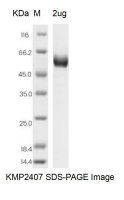
| Purity | >95% as determined by SDS-PAGE |
| Purification | Affinity purification |
| Endotoxin | <1.0 EU/ug determined by the LAL method |
| Formulation | 20mM PB, 150mM NaCl, pH7.4 |
| Background | B- and T-Lymphocyte Attenuator(BTLA) is a single-pass type I membrane protein containing 1 Ig-like V-type(immunoglobulin-like) domain. BTLA expression is induced during activation of T cells, and BTLA remains expressed on Th1 cells but not Th2 cells. Like PD1 and CTLA4, BTLA interacts with a B7 homolog, B7H4. However, unlike PD-1 and CTLA-4, BTLA displays T-Cell inhibition via interaction with tumor necrosis family receptors(TNF-R), not just the B7 family of cell surface receptors. BTLA is a lymphocyte inhibitory receptor that inhibits lymphocytes during immune response. BTLA also is a ligand for tumor necrosis factor(receptor) superfamily, member 14(TNFRSF14), also known as herpes virus entry mediator(HVEM). BTLA-HVEM complexes negatively regulate T-cell immune responses. |
| SDS-PAGE |  |
| Predicted Molecular Weight | 13.86 kDa |
| Storage Condition | Aliquot and store at -20℃ to -80℃. Avoid repeated freezing and thawing cycles. |
| Shipping Condition | In general, the proteins are provided as lyophilized powder which are shipped at ambient temperature. They are shipped out in dry ice if supplied in liquid form. |
| Uniprot ID | Q400G7 |


销售微信

官方公众号


 0
0