Mouse CD276 Protein, His Tag
-
产品编号
KMP2348
-
别名
共刺激分子蛋白, CD276 antigen, CD276, B7 homolog 3
-
规格
- 50ug
- 100ug
- 200ug
| Catalog Number | KMP2348 |
| Alias | 共刺激分子蛋白, CD276 antigen, CD276, B7 homolog 3 |
| Size | 50ug, 100ug, 200ug |
| Product Description | The Mouse CD276 Protein(KMP2348) is produced in HEK293 Cells and the target gene encoding Val29-Phe244 is expressed with a 6His tag at the C-terminus. |
| Molecular Name | CD276 |
| Product Introduction | CD276(B7-H3):免疫球蛋白超家族(IgSF)成员,通过跨膜形式参与免疫细胞活化和功能调节。 |
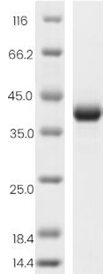
| Molecular Weight | 24.32 kDa |
| Expression System | HEK293 Cells |
| Species | Mouse |
| Purity | >95% |
| SDS-PAGE | |
| Purification | Affinity Purification |
| Uniprot ID | Q8VE98 |
| Storage Condition | Aliquot and store at -20℃ to -80℃. Avoid repeated freezing and thawing cycles. |
| Formulation | PBS, pH7.4 |
| Shipping Condition | In general, the proteins are provided as lyophilized powder which are shipped at ambient temperature. They are shipped out in dry ice if supplied in liquid form. |
| Background | CD276, also known as B7-H3, is a member of the B7 superfamily with signature IgV and IgG regions in extracellular domains. It is a type I transmembrane protein and shares 20–27% amino acid identity with other B7 family members. B7-H3 is involved in the activation of T lymphocytes, and regulates murine bone formation. It is also reported that B7-H3 may play an important role in muscle-immune interactions, providing further evidence of the active role of muscle cells in local immunoregulatory processes. B7-H3 is expressed on T-cells, natural killer cells, and antigen presenting cells, as well as some non-immune cells, such as osteoblasts, fibroblasts, fibroblast-like synoviocytes and epithelial cells. High expression of B7-H3 in tumor vasculature also correlates with poor survival in patients, suggesting that it may play a role in tumor cell migration. |
| Endotoxin | <1.0 EU/ug determined by the LAL method |
| Product Declaration | 该产品仅供科研使用,不可直接用于人体或注射。 |
蛋白可以在-80°C下储存以便长期保存。应分装并避免冻融循环,以保持蛋白的稳定性。
可以通过优化质粒设计、使用高效转染试剂、优化细胞培养条件以及使用蛋白折叠伴侣或密码子优化来提高蛋白表达效率。


销售微信

官方公众号


 0
0