Mouse INDO Protein, His Tag
-
产品编号
KMP2318
-
别名
吲哚 2, 3-二氧合酶 , Indole 2, 3-dioxygenase, INDO
-
规格
- 50ug
- 100ug
- 200ug
| Catalog Number | KMP2318 |
| Alias | 吲哚 2, 3-二氧合酶 , Indole 2, 3-dioxygenase, INDO |
| Size | 50ug, 100ug, 200ug |
| Product Description | The Mouse INDO Protein(KMP2318) is produced in E.coli and the target gene encoding Met1-Pro407 is expressed with a 6His tag at the N-terminus. |
| Molecular Name | INDO |
| Product Introduction | INDO(IDO1):色氨酸代谢限速酶,催化色氨酸沿犬尿氨酸途径的降解反应。 |
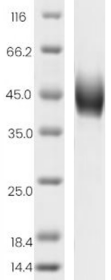
| Molecular Weight | 46.47 kDa |
| Expression System | E. coli |
| Species | Mouse |
| Purity | >95% |
| SDS-PAGE | |
| Purification | Affinity Purification |
| Uniprot ID | P28776 |
| Storage Condition | Aliquot and store at -20℃ to -80℃. Avoid repeated freezing and thawing cycles. |
| Formulation | 20mM Sodium Acetate, 150mM NaCl and 20% Glycerol, pH4.5 |
| Shipping Condition | In general, the proteins are provided as lyophilized powder which are shipped at ambient temperature. They are shipped out in dry ice if supplied in liquid form. |
| Background | Indoleamine 2,3-dioxygenase(IDO) is a heme enzyme that initiates the oxidative degradation of the least abundant, essential amino acid, l-tryptophan, along the kynurenine pathway. This protein is normally expressed in the dendritic cells, macrophages, microglia, eosinophils, fibroblasts, endothelial cells, and most tumor cells. IDO activity is associated with immunosuppression and immune attenuation. Several studies showed that IDO can contribute to immune escape when expressed directly in tumor cells or when expressed in immunosuppressive antigen presenting cells such as tolerogenic dendritic cells or tumor associated macrophages. IDO also is a promising therapeutic target for the treatment of cancer, chronic viral infections, and other diseases characterized by pathological immune suppression. |
| Endotoxin | <1.0 EU/ug determined by the LAL method |
| Product Declaration | 该产品仅供科研使用,不可直接用于人体或注射。 |
可优化表达条件(如降低诱导温度、调整IPTG浓度)、使用促溶标签(如SUMO、GST)、共表达分子伴侣,或尝试不同宿主系统(如哺乳动物细胞或昆虫细胞)以提高可溶性蛋白产量。
常用的纯化方法包括亲和层析(如His-Tag、GST-Tag)、离子交换层析、疏水相互作用层析(HIC)和凝胶过滤层析。具体方法取决于蛋白特性和标签类型。


销售微信

官方公众号


 0
0