Mouse CD80 Protein, Fc Tag
-
产品编号
KMP2398
-
别名
T淋巴细胞活化抗原CD80, T-lymphocyte activation antigen CD80, Activation B7-1 antigen
-
规格
- 50ug
- 100ug
- 200ug
| Alias | T淋巴细胞活化抗原CD80, T-lymphocyte activation antigen CD80, Activation B7-1 antigen |
| Catalog Number | KMP2398 |
| Product Description | The Mouse CD80 Protein(KMP2398) is produced in HEK293 Cells and the target gene encoding Val38-Lys245 is expressed with a Fc tag at the C-terminus. |
| Molecular Name | CD80 |
| Species | Mouse |
| Host | HEK293 Cells |
| Size | 50ug, 100ug, 200ug |
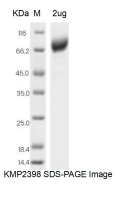
| Purity | >95% as determined by SDS-PAGE |
| Purification | Affinity purification |
| Endotoxin | <1.0 EU/ug determined by the LAL method |
| Formulation | PBS, pH7.4 |
| Background | Cluster of Differentiation 80, also called B7-1, is a member of cell surface immunoglobulin superfamily which plays key, yet distinct roles in the activation of T cells. It is the ligand for two different proteins on the T cell surface: CD28 and CTLA-4. Studies have shown that CTLA-4 binds mostly to CD80. The structure presents two extracellular domains: a membrane distal variable-like domain(IgV) and a membrane proximal Ig constant-like domain(IgC) along with an intracellular domain. Both IgV and IgC consist of anti-parallel beta sandwiches joined by a short linker region. CD80 is mostly expressed on the surface of antigen-presenting cells including activated B cells, macrophages and dendritic cells. |
| SDS-PAGE |  |
| Predicted Molecular Weight | 23.69 kDa |
| Storage Condition | Aliquot and store at -20℃ to -80℃. Avoid repeated freezing and thawing cycles. |
| Shipping Condition | In general, the proteins are provided as lyophilized powder which are shipped at ambient temperature. They are shipped out in dry ice if supplied in liquid form. |
| Uniprot ID | Q3U4B5 |


销售微信

官方公众号


 0
0