Human CD279 Protein, His Tag, Avi Tag
-
产品编号
KMP2259
-
别名
程序性死亡分子, Programmed cell death protein 1
-
规格
- 50ug
- 100ug
- 200ug
| Alias | 程序性死亡分子, Programmed cell death protein 1 |
| Catalog Number | KMP2259 |
| Product Description | The Human CD279 Protein(KMP2259) is produced in HEK293 Cells and the target gene encoding Pro21-Gln167 is expressed with a 6His, Avi tag at the C-terminus. |
| Molecular Name | CD279 |
| Species | Human |
| Host | HEK293 Cells |
| Size | 50ug, 100ug, 200ug |
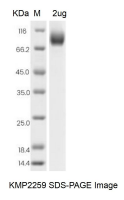
| Purity | >95% as determined by SDS-PAGE |
| Purification | Affinity purification |
| Endotoxin | <1.0 EU/ug determined by the LAL method |
| Formulation | PBS, pH7.4 |
| Background | Programmed cell death protein 1(PDCD1) is a single-pass type I membrane protein and contains 1 Ig-like V-type domain. PD-1 is a member of the extended CD28/CTLA-4 family of T cell regulators. PDCD1 inhibits the T-cell proliferation and production of related cytokines including IL-1, IL-4, IL-10 and IFN-γ by suppressing the activation and transduction of PI3K/AKT pathway. In addition, coligation of PDCD1 inhibits BCR-mediating signal by dephosphorylating key signal transducer. PDCD1 has been suggested to be involved in lymphocyte clonal selection and peripheral tolerance, and thus contributes to the prevention of autoimmune diseases. As a cell surface molecule, PDCD1 regulates the adaptive immune response. Engagement of PD-1 by its ligands PD-L1 or PD-L2 transduces a signal that inhibits T-cell proliferation, cytokine production, and cytolytic function. |
| SDS-PAGE |  |
| Predicted Molecular Weight | 17.26 kDa |
| Storage Condition | Aliquot and store at -20℃ to -80℃. Avoid repeated freezing and thawing cycles. |
| Shipping Condition | In general, the proteins are provided as lyophilized powder which are shipped at ambient temperature. They are shipped out in dry ice if supplied in liquid form. |
| Uniprot ID | Q15116 |
| References | 1.Ann. N. Y. Acad. Sci. 1217:45-59 (2011) 2.N. Engl. J. Med. 366:2443-2454 (2012) 3.Lancet 384:1109-1117 (2014) 4.N. Engl. J. Med. 372:320-330 (2015) |
| Function | Inhibitory receptor on antigen activated T-cells that plays a critical role in induction and maintenance of immune tolerance to self (PubMed:21276005). Delivers inhibitory signals upon binding to ligands CD274/PDCD1L1 and CD273/PDCD1LG2 (PubMed:21276005). Following T-cell receptor (TCR) engagement, PDCD1 associates with CD3-TCR in the immunological synapse and directly inhibits T-cell activation (By similarity). Suppresses T-cell activation through the recruitment of PTPN11/SHP-2: following ligand-binding, PDCD1 is phosphorylated within the ITSM motif, leading to the recruitment of the protein tyrosine phosphatase PTPN11/SHP-2 that mediates dephosphorylation of key TCR proximal signaling molecules, such as ZAP70, PRKCQ/PKCtheta and CD247/CD3zeta (By similarity). The PDCD1-mediated inhibitory pathway is exploited by tumors to attenuate anti-tumor immunity and escape destruction by the immune system, thereby facilitating tumor survival (PubMed:28951311). The interaction with CD274/PDCD1L1 inhibits cytotoxic T lymphocytes (CTLs) effector function (PubMed:28951311). The blockage of the PDCD1-mediated pathway results in the reversal of the exhausted T-cell phenotype and the normalization of the anti-tumor response, providing a rationale for cancer immunotherapy (PubMed:22658127, PubMed:25034862, PubMed:25399552). |


销售微信

官方公众号


 0
0