

Mouse CD47 Protein, His Tag
-
产品编号
KMP2317
-
别名
整联蛋白相关蛋白, Leukocyte Surface Antigen CD47, MER6
-
规格
- 50ug
- 100ug
- 200ug
| Alias | 整联蛋白相关蛋白, Leukocyte Surface Antigen CD47, MER6 |
| Catalog Number | KMP2317 |
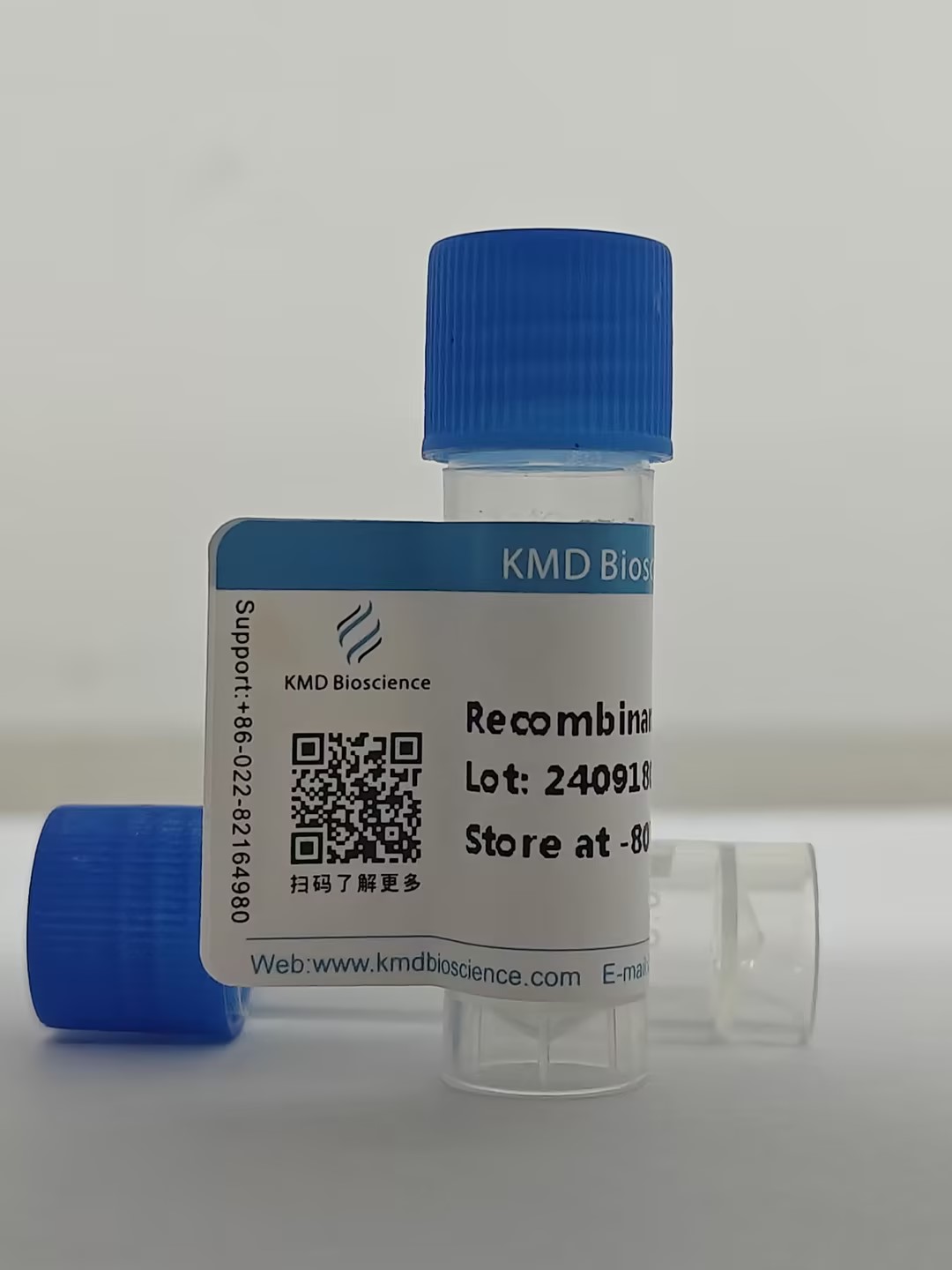
| Product Description | The Mouse CD47 Protein(KMP2317) is produced in HEK293 Cells and the target gene encoding Gln19-Pro158 is expressed with a 6His tag at the C-terminus. |
| Molecular Name | CD47 |
| Species | Mouse |
| Host | HEK293 Cells |
| Size | 50ug, 100ug, 200ug |
| Purity | >95% as determined by SDS-PAGE |
| Concentration | 联系销售经理获得最新批次的浓度 |
| Purification | Affinity purification |
| Endotoxin | <1.0 EU/ug determined by the LAL method |
| Formulation | PBS, pH7.4 |
| Background | CD47, also known as Integrin-Associated Protein(IAP) and OA3, is a glycosylated atypical member of the immunoglobulin superfamily. Mouse CD47 is an integral membrane protein that consists of a extracellular domain(ECD) with a single Ig-like domain, five membrane-spanning regions with short intervening loops, and C-terminal cytoplasmic tail. CD47 has a role in both cell adhesion by acting as an adhesion receptor for THBS1 on platelets, and in the modulation of integrins. It plays an important role in memory formation and synaptic plasticity in the hippocampus. As a receptor for SIRPA, it binding to which prevents maturation of immature dendritic cells and inhibits cytokine production by mature dendritic cells. Interaction with SIRPG mediates cellcell adhesion, it enhances superantigen-dependent T-cell-mediated proliferation and costimulates T-cell activation. It may play a role in membrane transport and/or integrin dependent signal transduction. It also prevents premature elimination of red blood cells. |
| Cross-reactivity | No cross-reactivity with other antigens or proteins. |
| Predicted Molecular Weight | 16.06 kDa |
| Predicted N Terminus | Met |
| Storage Condition | Aliquot and store at -20℃ to -80℃. Avoid repeated freezing and thawing cycles. |
| Shipping Condition | In general, the proteins are provided as lyophilized powder which are shipped at ambient temperature. They are shipped out in dry ice if supplied in liquid form. |
| Uniprot ID | Q61735 |
| References | 1.Science 288:2051-2054 (2000) 2.J. Biol. Chem. 280:29637-29644 (2005) 3.Ann. Surg. 247:180-190 (2008) 4.Cardiovasc. Res. 88:471-481 (2010) 5.Sci. Rep. 3:1673-1673 (2013) 6.Cardiovasc. Res. 113:15-29 (2017) 7.Cells 9:0-0 (2020) |
| Function | Adhesive protein that mediates cell-to-cell interactions (By similarity). Acts as receptor for thrombospondin THBS1 and as modulator of integrin signaling through the activation of heterotrimeric G proteins (By similarity). Involved in signal transduction, cardiovascular homeostasis, inflammation, apoptosis, angiogenesis, cellular self-renewal, and immunoregulation (PubMed:27742621, PubMed:20610415, PubMed:23591719). Plays a role in modulating pulmonary endothelin EDN1 signaling (PubMed:27742621). Modulates nitrous oxide (NO) signaling, in response to THBS1, hence playing a role as a pressor agent, supporting blood pressure (PubMed:20610415). Plays an important role in memory formation and synaptic plasticity in the hippocampus (By similarity). Receptor for SIRPA, binding to which prevents maturation of immature dendritic cells and inhibits cytokine production by mature dendritic cells (By similarity). Interaction with SIRPG mediates cell-cell adhesion, enhances superantigen-dependent T-cell-mediated proliferation and costimulates T-cell activation (By similarity). Positively modulates FAS-dependent apoptosis in T-cells, perhaps by enhancing FAS clustering (PubMed:15917238). Plays a role in suppressing angiogenesis and may be involved in metabolic dysregulation during normal aging (PubMed:32679764). In response to THBS1, negatively modulates wound healing (PubMed:18156939). Inhibits stem cell self-renewal, in response to THBS1, probably by regulation of the stem cell transcription factors POU5F1/OCT4, SOX2, MYC/c-Myc and KLF4 (PubMed:23591719). May play a role in membrane transport and/or integrin dependent signal transduction (By similarity). May prevent premature elimination of red blood cells (PubMed:10856220). |
| Product Declaration | 该产品仅供科研使用,不可直接用于人体或注射。 |
| Temperature Range | Store the product under sterile conditions after opening at -80℃ for 12 months. Store the lyophilized powder at -25℃. Avoid repeated freeze-thaw cycles. |


销售微信

官方公众号


 0


