

Human FGFR1 Protein, hFc Tag
-
产品编号
KMP3373
-
别名
成纤维细胞生长因子受体-1, Human FGFR1 Protein, hFc Tag, FGFR1
-
目录价格
联系客服获取报价RMB
-
规格
- 50ug
- 100ug
- 200ug
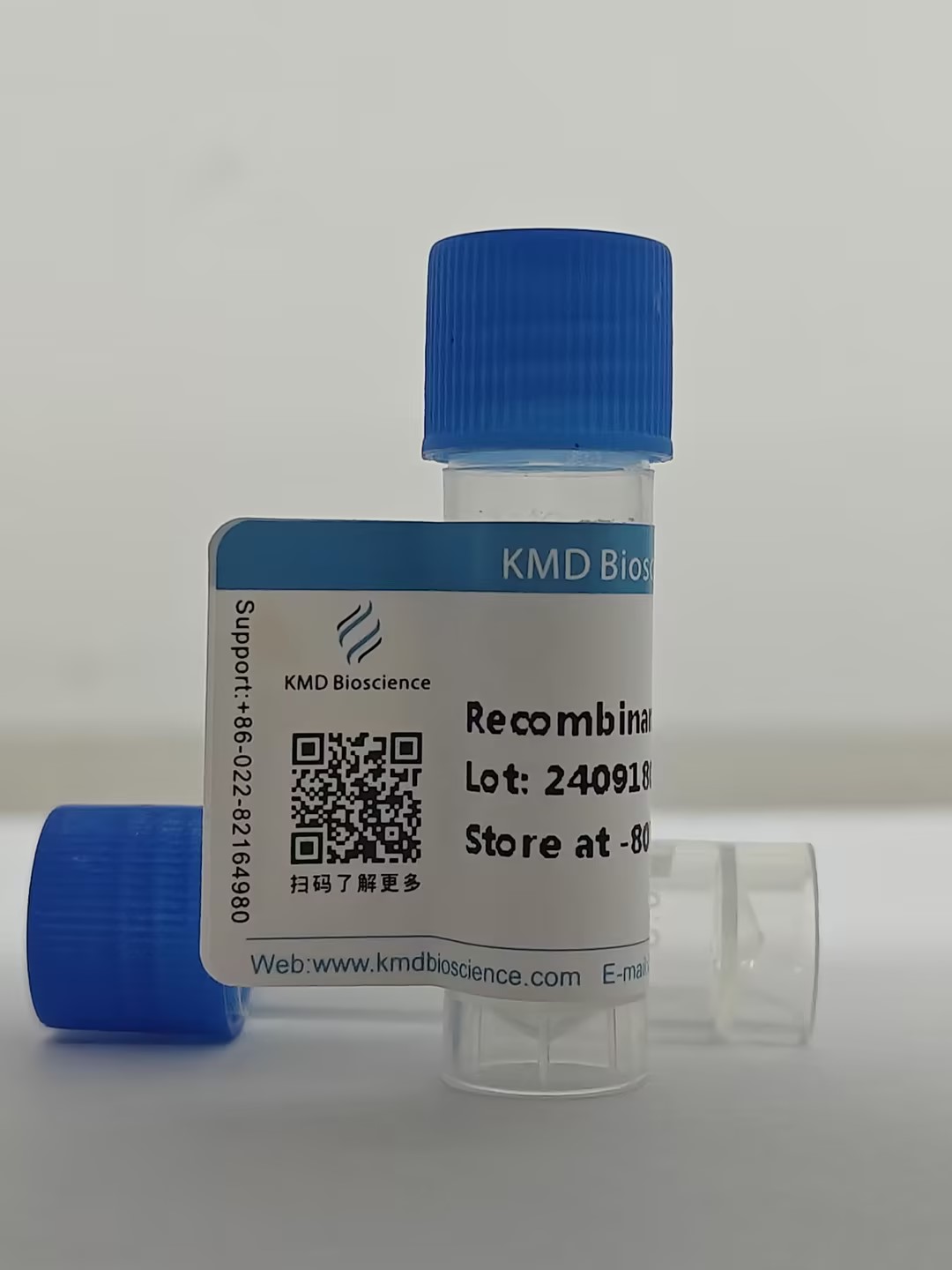
| Alias | 成纤维细胞生长因子受体-1, Human FGFR1 Protein, hFc Tag, FGFR1 |
| Catalog Number | KMP3373 |
| Product Description | The Human FGFR1 Protein(KMP3373) is produced in HEK293 Cells. The target gene encoding the human FGFR1 beta (IIIb) (NP_075594.1) (Met1-Lys221 and Ala270-Glu285 linked by the FGFR1 IIIb Ig domain (AAB19502.1) (His1-Pro47)) is expressed with the Fc region of human IgG1 at the C-terminus. |
| Molecular Name | FGFR1 |
| Species | Human |
| Host | HEK293 Cells |
| Size | 50ug, 100ug, 200ug |
| Protein Family | CD molecule |
| Purity | >95% as determined by SDS-PAGE |
| Concentration | 联系销售经理获得最新批次的浓度 |
| Purification | Affinity purification |
| Endotoxin | <1.0 EU/ug determined by the LAL method |
| Formulation | PBS, pH7.4 |
| Background | FGFR1, also known as CD331, belongs to the fibroblast growth factor receptor subfamily where amino acid sequence is highly conserved between members and throughout evolution. FGFR family members differ from one another in their ligand affinities and tissue distribution. Fibroblast growth factors (FGFs) (FGF1 - 10 and 16 - 23) are mitogenic signaling molecules that have roles in angiogenesis, wound healing, cell migration, neural outgrowth and embryonic development. FGFs bind heparan sulfate glycosaminoglycans, which facilitates dimerization (activation) of FGF receptors. FGFR1 is a full-length representative protein consists of an extracellular region, composed of three immunoglobulin-like domains, a single hydrophobic membrane-spanning segment and a cytoplasmic tyrosine kinase domain. The extracellular portion of FGFR1 interacts with fibroblast growth factors, setting in motion a cascade of downstream signals, ultimately influencing mitogenesis and differentiation. This particular family member binds both acidic and basic fibroblast growth factors and is involved in limb induction. CD331 can be detected in astrocytoma, neuroblastoma and adrenal cortex cell lines. Some isoforms are detected in foreskin fibroblast cell lines, however isoform 17, isoform 18 and isoform 19 are not detected in these cells. Defects in FGFR1 are a cause of Pfeiffer syndrome ,idiopathic hypogonadotropic hypogonadism, Kallmann syndrome type 2, osteoglophonic dysplasia and trigonocephaly non-syndromic. |
| Application | WB, ELISA |
| Recommended Dilution | ELISA: 1:100-1:1000 |
| Cross-reactivity | No cross-reactivity with other antigens or proteins. |
| Predicted Molecular Weight | 56 kDa |
| Predicted N Terminus | Met |
| Reconstitution | Not applicable. The product is supplied as a ready-to-use liquid formulation. |
| Storage Condition | Aliquot and store at -20℃ to -80℃. Avoid repeated freezing and thawing cycles. |
| Remarks | 收到产品后请立即按保存条件储存;使用前短暂离心,使内容物集中于管底;避免反复冻融。 |
| Shipping Condition | In general, recombinant proteins are provided as lyophilized powder which are shipped at ambient temperature. If supplied as liquid, the proteins will be shipped with dry ice. |
| Stability | Samples are stable for up to twelve months from date of receipt at -20℃ to -80℃. Store it under sterile conditions at -20℃ to -80℃. It is recommended that the protein be aliquoted for optimal storage. Avoid repeated freeze-thaw cycles. |
| Molecular Weight | 56 kDa |
| Cross-reactivity | No cross-reactivity with other antigens or proteins. |
| Note | 仅供科研使用 |
| ELISA IC50(ppb) | ≥ 1:1000 |
| Function | FGFR1, also known as CD331, belongs to the fibroblast growth factor receptor subfamily where amino acid sequence is highly conserved between members and throughout evolution. FGFR family members differ from one another in their ligand affinities and tissue distribution. Fibroblast growth factors (FGFs) (FGF1 - 10 and 16 - 23) are mitogenic signaling molecules that have roles in angiogenesis, wound healing, cell migration, neural outgrowth and embryonic development. FGFs bind heparan sulfate glycosaminoglycans, which facilitates dimerization (activation) of FGF receptors. FGFR1 is a full-length representative protein consists of an extracellular region, composed of three immunoglobulin-like domains, a single hydrophobic membrane-spanning segment and a cytoplasmic tyrosine kinase domain. The extracellular portion of FGFR1 interacts with fibroblast growth factors, setting in motion a cascade of downstream signals, ultimately influencing mitogenesis and differentiation. This particular family member binds both acidic and basic fibroblast growth factors and is involved in limb induction. CD331 can be detected in astrocytoma, neuroblastoma and adrenal cortex cell lines. Some isoforms are detected in foreskin fibroblast cell lines, however isoform 17, isoform 18 and isoform 19 are not detected in these cells. Defects in FGFR1 are a cause of Pfeiffer syndrome ,idiopathic hypogonadotropic hypogonadism, Kallmann syndrome type 2, osteoglophonic dysplasia and trigonocephaly non-syndromic. |
| Product Declaration | 该产品仅供科研使用,不可直接用于人体或注射。 |
| Temperature Range | -20℃ ~ -80℃ |
| Solubility | 产品为即用型液体,无需复溶。 |
| Appearance | Liquid |
| Product Full Name | Human FGFR1 Protein |
| Preservative Solution | PBS, pH7.4 |
| Usage Method | 冻干粉请按“复溶”说明用无菌去离子水复溶后使用,液体产品可直接使用;具体工作浓度请参考“推荐稀释比例”。 |
| Target | FGFR1 |


销售微信

官方公众号


 0


