

Human CD299 Protein
-
产品编号
KMP2649
-
别名
C 型凝集素结构域家族 4,成员 M, Human CD299 Protein, CD299
-
目录价格
联系客服获取报价RMB
-
规格
- 50ug
- 100ug
- 200ug
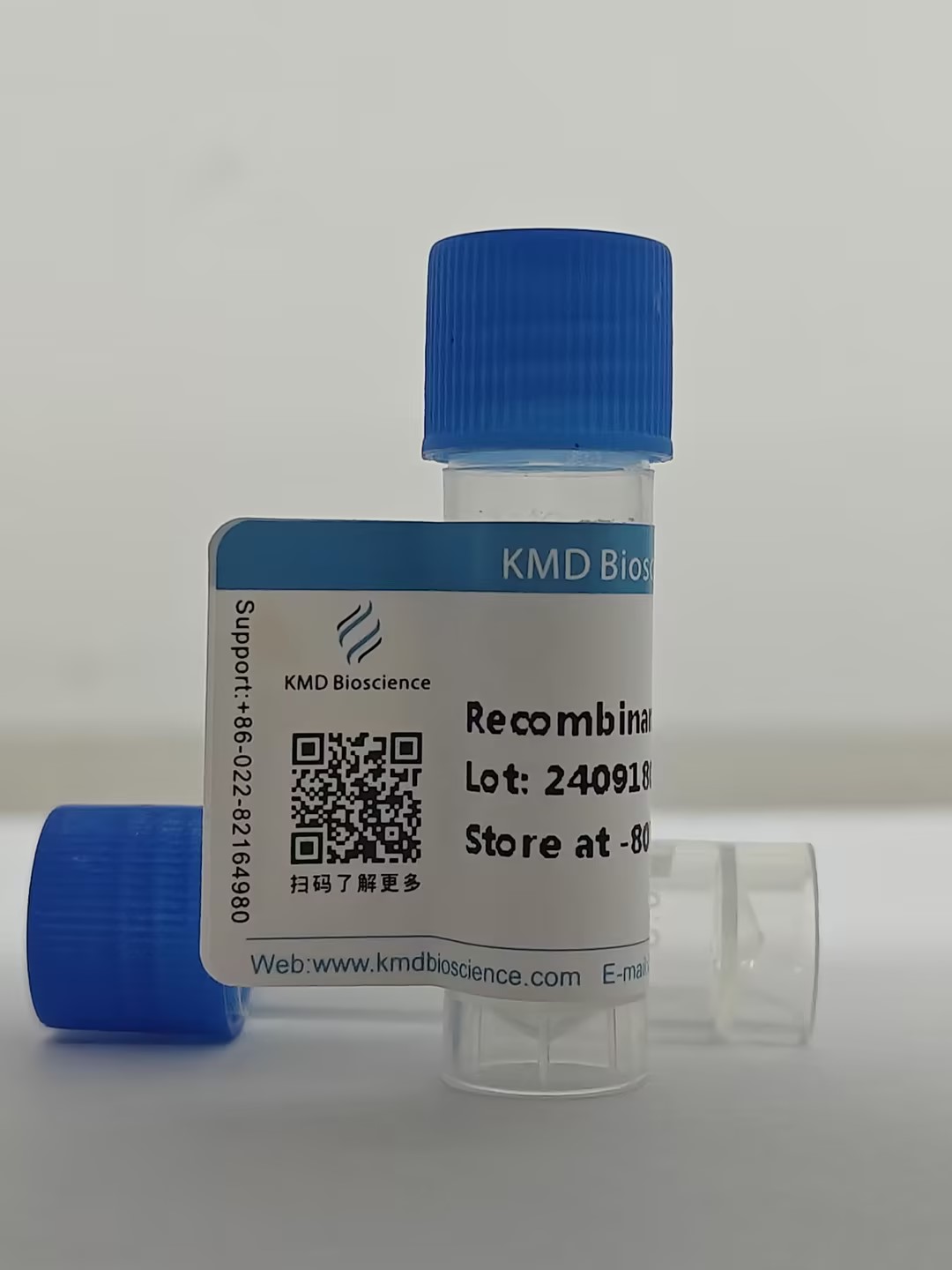
| Alias | C 型凝集素结构域家族 4,成员 M, Human CD299 Protein, CD299 |
| Catalog Number | KMP2649 |
| Product Description | The Human CD299 Protein(KMP2649) is produced in HEK293 Cells. The target gene encoding the human CLEC4M (NP_055072.3) (Ser78-Glu399) is expressed. |
| Molecular Name | CD299 |
| Species | Human |
| Host | HEK293 Cells |
| Size | 50ug, 100ug, 200ug |
| Protein Family | CD molecule |
| Purity | >80% as determined by SDS-PAGE |
| Concentration | 联系销售经理获得最新批次的浓度 |
| Purification | Affinity purification |
| Endotoxin | <1.0 EU/ug determined by the LAL method |
| Formulation | PBS, pH7.4 |
| Background | C-type lectin domain family 4, member M, also known as DC-SIGNR and CLEC4M, is a type II integral membrane protein that is 77% amino acid identical to DC-SIGN, an HIV gp120-binding protein. Though the encoded gene located in the same chromosome, DC-SIGN is expressed solely on dendritic cells, while DC-SIGNR is predominantly found in liver sinusoidal endothelial cells and lymph node, as well as placental endothelium. DC-SIGNR exists as a homotetramer, and the tandem repeat domain, also called neck domain, mediates oligomerization. DC-SIGNR is regarded as a pathogen-recognition receptor involved in peripheral immune surveillance in liver, and probably mediates the endocytosis of pathogens which are subsequently degraded in lysosomal compartments. DC-SIGNR appears to selectively recognize and bind many viral surface glycoproteins containing high mannose N-linked oligosaccharides in a calcium-dependent manner, including HIV-1 gp120, HIV-2 gp120, SIV gp120, ebolAvirus glycoproteins, HCV E2, and human SARS coronAvirus protein S, as well as the cellular adhesion protein ICAM3. DC-SIGNR has been thought to play an important role in establishing HIV infection by enhancing trans-infection of CD4(+)T cells in the regional lymph nodes. It may affect susceptibility to HIV infection by a mechanism that is different in females and males. DC-SIGNR can bind to hepatitis C virus (HCV), and its polymorphism might affect HCV loads supporting the concept that DC-SIGNR contributes to HCV replication efficacy. |
| Application | WB, ELISA |
| Recommended Dilution | ELISA: 1:100-1:1000 |
| Cross-reactivity | No cross-reactivity with other antigens or proteins. |
| Predicted Molecular Weight | 37 kDa |
| Predicted N Terminus | Ser 78 |
| Reconstitution | Not applicable. The product is supplied as a ready-to-use liquid formulation. |
| Storage Condition | Aliquot and store at -20℃ to -80℃. Avoid repeated freezing and thawing cycles. |
| Remarks | 收到产品后请立即按保存条件储存;使用前短暂离心,使内容物集中于管底;避免反复冻融。 |
| Shipping Condition | In general, recombinant proteins are provided as lyophilized powder which are shipped at ambient temperature. If supplied as liquid, the proteins will be shipped with dry ice. |
| Stability | Samples are stable for up to twelve months from date of receipt at -20℃ to -80℃. Store it under sterile conditions at -20℃ to -80℃. It is recommended that the protein be aliquoted for optimal storage. Avoid repeated freeze-thaw cycles. |
| Molecular Weight | 37 kDa |
| Cross-reactivity | No cross-reactivity with other antigens or proteins. |
| Note | 仅供科研使用 |
| ELISA IC50(ppb) | ≥ 1:1000 |
| Function | C-type lectin domain family 4, member M, also known as DC-SIGNR and CLEC4M, is a type II integral membrane protein that is 77% amino acid identical to DC-SIGN, an HIV gp120-binding protein. Though the encoded gene located in the same chromosome, DC-SIGN is expressed solely on dendritic cells, while DC-SIGNR is predominantly found in liver sinusoidal endothelial cells and lymph node, as well as placental endothelium. DC-SIGNR exists as a homotetramer, and the tandem repeat domain, also called neck domain, mediates oligomerization. DC-SIGNR is regarded as a pathogen-recognition receptor involved in peripheral immune surveillance in liver, and probably mediates the endocytosis of pathogens which are subsequently degraded in lysosomal compartments. DC-SIGNR appears to selectively recognize and bind many viral surface glycoproteins containing high mannose N-linked oligosaccharides in a calcium-dependent manner, including HIV-1 gp120, HIV-2 gp120, SIV gp120, ebolAvirus glycoproteins, HCV E2, and human SARS coronAvirus protein S, as well as the cellular adhesion protein ICAM3. DC-SIGNR has been thought to play an important role in establishing HIV infection by enhancing trans-infection of CD4(+)T cells in the regional lymph nodes. It may affect susceptibility to HIV infection by a mechanism that is different in females and males. DC-SIGNR can bind to hepatitis C virus (HCV), and its polymorphism might affect HCV loads supporting the concept that DC-SIGNR contributes to HCV replication efficacy. |
| Product Declaration | 该产品仅供科研使用,不可直接用于人体或注射。 |
| Temperature Range | -20℃ ~ -80℃ |
| Solubility | 产品为即用型液体,无需复溶。 |
| Appearance | Liquid |
| Product Full Name | Human CD299 Protein |
| Preservative Solution | PBS, pH7.4 |
| Usage Method | 冻干粉请按“复溶”说明用无菌去离子水复溶后使用,液体产品可直接使用;具体工作浓度请参考“推荐稀释比例”。 |
| Target | CD299 |


销售微信

官方公众号


 0

